
I have spent nearly twenty years working with mission-driven leaders who know their work matters but struggle to explain why it matters in ways that move people. They have the right values. They have compelling programs. They have data that proves impact. But somewhere between intention and expression, something gets lost.
The problem is not about finding better words. It is about something deeper that I have come to call spatial blindness.
The Problem: When Narrative Coherence Collapses
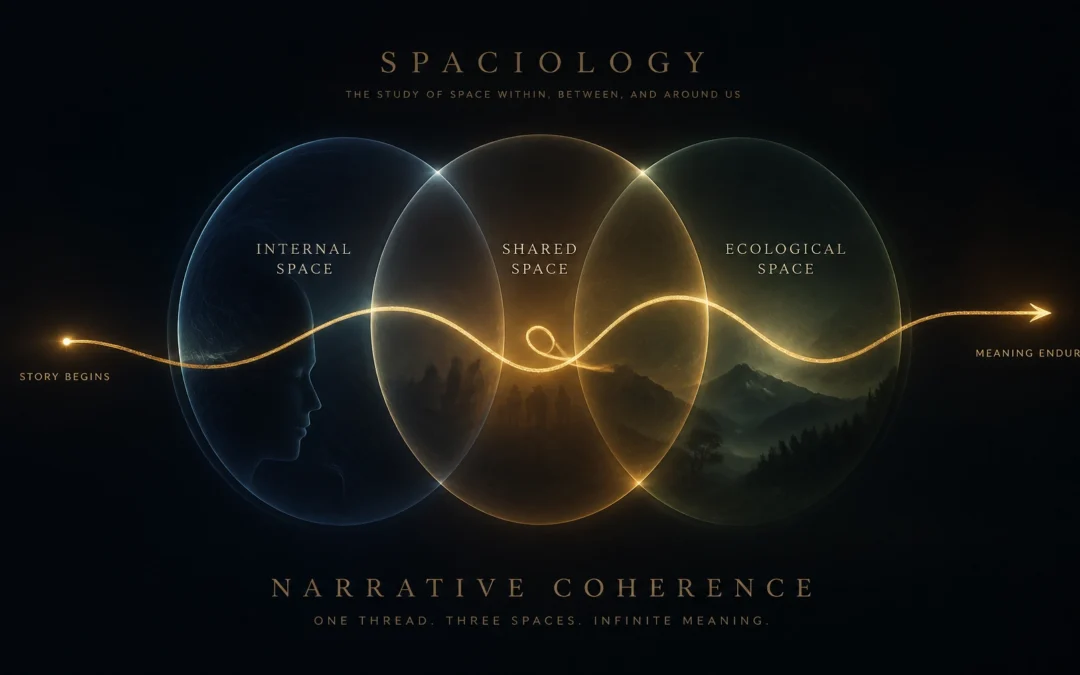
Leaders and organizations lose narrative coherence not because they lack communication skills. They lose it because something in the space has shifted and has not been named. The space I am talking about operates on three levels: the stories you carry about yourself, the stories you build with others, and the larger field of culture and systems you operate within.
When these spaces change without acknowledgment, your narrative starts to fracture. You say one thing in a board meeting and another thing in a grant proposal. Your team members describe the same program in fundamentally different ways. Your mission statement feels hollow even though every word is technically accurate.
Harvard research identifies these as narrative contradictions: statements that are individually accurate yet collectively conflicting, emerging from organizational complexity and fragmented accountability.
Surface-level story fixes do not work because the relational space has not been addressed. You can hire a consultant to polish your messaging. You can workshop your elevator pitch. You can redesign your website. But if the underlying spatial dynamics remain unexamined, the incoherence returns.
- Notice where your narrative fractures across audiences.
- Name the spatial shift before reaching for a messaging fix.
- Treat returning incoherence as a signal, not a setback.
The Framework: Space as Metaphor
I developed a framework called Spaciology to address this problem. It treats space not as empty container but as active participant in how meaning emerges and how narratives hold together.
The framework operates across three dimensions:
Internal Space refers to the stories you carry about yourself. Your assumptions about leadership. Your relationship to authority. The narratives you inherited about what success looks like or what your role should be. This space shapes what you notice and what you ignore.
Shared Space refers to the relational field you create with others. How you listen. How you hold difference. How you navigate conflict. How internal spaces interact, intersect, or resist each other. This is where organizational culture actually lives, beneath the stated values.
Ecological Space refers to the larger systems and contexts you operate within. Funding structures. Political climates. Historical patterns. Cultural memory. The field that shapes what is possible and what is thinkable in any given moment.
Within each dimension, you make three moves: making space (creating conditions for something new to emerge), mapping space (understanding the terrain you are actually in), and maintaining space (sustaining the conditions over time).
This is not a step-by-step method. It is a way of seeing that changes how you approach narrative work entirely.
- Identify which dimension is most active right now.
- Choose whether the moment calls for making, mapping, or maintaining.
- Resist collapsing all three dimensions into one quick fix.
The Process: EcoDialogues
I translate this framework into practice through a methodology called EcoDialogues. It works as both individual coaching and organizational facilitation, structured across three sessions that correspond to the three spatial dimensions.
Session One: Internal Space
We begin with guided questions designed to surface the stories you carry without forcing premature articulation. I ask you to notice what emerges when you sit with a question rather than rushing to answer it. We work with somatic awareness because your body often knows things before your conscious mind catches up.
The practice here is Active Receptivity. You learn to receive what arises without immediately categorizing it as good or bad, right or wrong. David Bohm argued that dialogue aims at changing the way thought occurs collectively, and that we have paid attention to content but not to process. This session focuses on process.
In coaching contexts, this looks like one-on-one inquiry into your leadership identity and the narratives shaping your decisions. In workshop contexts, this becomes individual reflection time before any group dialogue begins.
- Sit with a question before answering it.
- Track somatic signals alongside cognitive responses.
- Suspend judgment long enough for honest material to surface.
Session Two: Shared Space
We move into relational dialogue. Not debate. Not consensus-building. Not problem-solving. Just witnessing how different internal spaces show up in relation to each other.
You learn to hold your perspective while genuinely encountering someone else’s. You notice where alignment exists and where resistance appears. You practice staying present when discomfort arises, rather than smoothing it over or forcing a resolution.
This is where organizational narrative work gets real. Teams discover they have been using the same words to mean fundamentally different things. Board members realize their strategic disagreements are actually rooted in unspoken assumptions about the organization’s purpose.
The practice here is learning to map the relational field without trying to fix it prematurely. Sometimes the most important work is simply naming what is actually happening.
- Map the relational field before trying to change it.
- Name shared vocabulary that hides divergent meaning.
- Stay present through discomfort instead of resolving it prematurely.
Session Three: The Field
We zoom out to the ecological level. What systemic patterns are shaping this conversation? What cultural narratives are operating beneath the surface? What historical dynamics are influencing what feels possible right now?
This session involves mapping organizational culture, examining collective memory, and identifying the larger forces at play. Robin Wall Kimmerer teaches that restoration is relational, requiring us to restore relationships rather than just fix technical problems. This applies to organizations as much as ecosystems.
The practice here is Accountability Over Accuracy. You stop trying to get the story perfectly right and start asking what this narrative is accountable to. Who does it serve? What does it make possible? What does it foreclose?
In coaching, this becomes examining how your individual narrative fits within larger systems of power and culture. In workshops, this becomes strategic alignment work grounded in honest assessment of the field you operate within.
- Identify the systemic forces shaping what feels possible.
- Ask who the narrative is accountable to, not just whether it is correct.
- Examine what your story makes possible and what it forecloses.
What Emerges
I hold four outcomes loosely, knowing coherence looks different for each person and organization:
Perspective Transformation. Jack Mezirow defined this as becoming aware that you are caught in your own history and reliving it, leading to structural change in how you see yourself and your relationships. This is not about getting new information. It is about fundamentally shifting the frame through which you interpret experience.
Relational and Collective Intelligence. You develop capacity to navigate complexity with others rather than trying to resolve it alone. You learn to work with difference instead of eliminating it. You build organizational cultures where coherence emerges from genuine dialogue rather than imposed messaging.
Space-Making Competencies. You get better at creating conditions for meaningful conversation. You learn to hold space for discomfort without rushing to resolution. You develop skill in mapping the terrain before trying to change it.
Ongoing Practice. This is not a one-time intervention. Each engagement feeds a growing framework. You become a practitioner of this approach rather than just a participant in a workshop. The work continues beyond our formal sessions.
- Treat coherence as an emergent property, not a deliverable.
- Build capacity to work with difference instead of eliminating it.
- Continue the practice beyond the formal engagement.
Working with Me
I offer two tracks:
Coaching is for individuals navigating transitions, complexity, identity questions, or leadership reimagination. We use EcoDialogues as the container for personal narrative work grounded in spatial awareness. This is for you if you know something needs to shift but you cannot quite name what it is yet.
Workshops are for teams, boards, and organizations needing strategic alignment, narrative coherence, culture work, campaign readiness, or leadership clarity. We use EcoDialogues as facilitated organizational dialogue. This is for you if your organization keeps having the same conversation without resolution or if your team uses the same language to mean different things.
I am Robert Levey. I hold a PhD and MBA. I serve as senior faculty at UNH College of Professional Studies and as Executive Director of UYM Charities. I founded RPL to specialize in narrative strategy for mission-driven organizations. I have spent nearly twenty years learning how meaning moves through systems and how to help leaders work with that movement rather than against it.
If this resonates, reach me at robert@exponentialsquared.com or 603-369-1046.
Grounding
This framework draws from multiple traditions of inquiry:
David Bohm on dialogue as collective thought process and the importance of examining how we think, not just what we think.
Jack Mezirow on transformative learning through experience, reflection, and discourse, particularly the concept of disorienting dilemmas that catalyze perspective shifts.
J. Krishnamurti on self-inquiry and the examination of consciousness without predetermined frameworks.
Peter Senge on systems thinking and organizational learning, particularly how mental models shape what we perceive as possible.
Robin Wall Kimmerer on relational epistemologies and the integration of Indigenous and Western ways of knowing, emphasizing that knowledge emerges through relationship rather than extraction.
Tyson Yunkaporta on Indigenous thinking systems and the importance of pattern recognition across multiple scales and contexts.
This is not an exhaustive list. It signals the depth this work draws from without claiming to contain it all.
The work continues. Each engagement teaches me something new about how space operates and how narratives find coherence. I invite you into that ongoing inquiry.
This post is grounded in the Space as Metaphor framework, which views space as "metaphor for method, moral orientation, and mode of transformation." The framework helps us understand that our actions are not merely transactional exchanges, but choices within sacred spaces requiring careful cultivation and ethical stewardship.
About Spaciology
Spaciology is not abstract theory; rather, it is a practice you can feel.
- Inside: Pause, breathe, notice.
- Outside: Design rooms, rituals, and agendas that slow the spin and invite care.
- Between us: Make dialogue a place where different truths can live together long enough to teach something.
Ultimately, leadership is the art of making space for what’s important (for everyone) and letting that clarity shape the next step. When we change the spaces from which we lead, our strategies change with them.
Spaciology Learning Commons
Want to go further? Join the Spaciology Learning Commons.
Membership is free gives you access to community conversations, courses, introductory resources, and the complete Field Guide.