
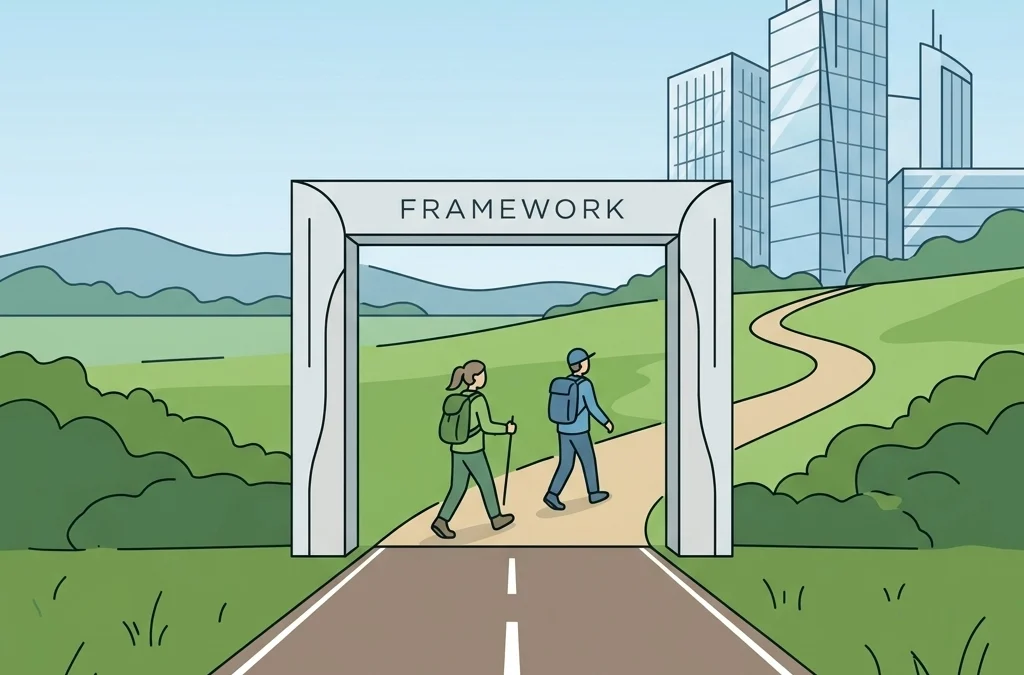
The Limits of Traditional Frameworks
Traditional management and coaching frameworks often rely on linear planning, fixed roles, and measurable outputs. These tools can be useful in stable conditions, but they often fail when leadership takes shape inside uncertainty, conflict, and change. They reduce complexity to a sequence of steps and assume that people and institutions behave like predictable machines.
That assumption does not hold in living systems. Leaders do not act from metrics alone. Teams do not respond only to structure. Institutions are shaped by meaning, relationships, history, and pressure from the larger field around them.
Why a Shift in Space Matters
A more useful approach starts by treating organizational life as space rather than as a fixed map. Space can hold movement, contradiction, and emergence. It allows attention to what is happening within a person, between people, and across the wider system at the same time.
This view makes room for three connected dimensions:
- the personal space of values, perception, and decision-making
- the relational space of trust, conflict, and communication
- the larger field in which institutions, culture, and external conditions shape action
When these spaces are separated, decision-making becomes narrow. A framework may produce short-term order while missing the deeper causes of confusion or misalignment.
What Holistic Systems Make Possible
Holistic systems do not begin with control. They begin with observation, context, and pattern recognition. Instead of forcing action through a preset model, they ask what the system is revealing and what form of response fits the actual conditions.
- Observation: noticing the space as it is before imposing a solution
- Alignment: connecting internal values, relationships, and institutional direction
- Emergence: allowing the next move to arise from the full system rather than from habit
The limitation of traditional management is not that structure has no place. The limitation is that structure alone cannot account for human depth, relational strain, or systemic complexity. More holistic systems are necessary because leadership is never only technical. It is always personal, relational, and shaped by the larger field.
True impact comes from how a leader chooses to show up in the space they inhabit. Explore more about narrative strategy to see how stories shape these professional environments.
This post is grounded in the Space as Metaphor framework, which views space as "metaphor for method, moral orientation, and mode of transformation." The framework helps us understand that our actions are not merely transactional exchanges, but choices within sacred spaces requiring careful cultivation and ethical stewardship.
About Spaciology
Spaciology is not abstract theory; rather, it is a practice you can feel.
- Inside: Pause, breathe, notice.
- Outside: Design rooms, rituals, and agendas that slow the spin and invite care.
- Between us: Make dialogue a place where different truths can live together long enough to teach something.
Ultimately, leadership is the art of making space for what is important (for everyone) and letting that clarity shape the next step. When we change the spaces from which we lead, our strategies change with them.
Spaciology Learning Commons
Want to go further? Join the Spaciology Learning Commons.
Membership is free and gives you access to community conversations, courses, introductory resources, and the complete Field Guide.